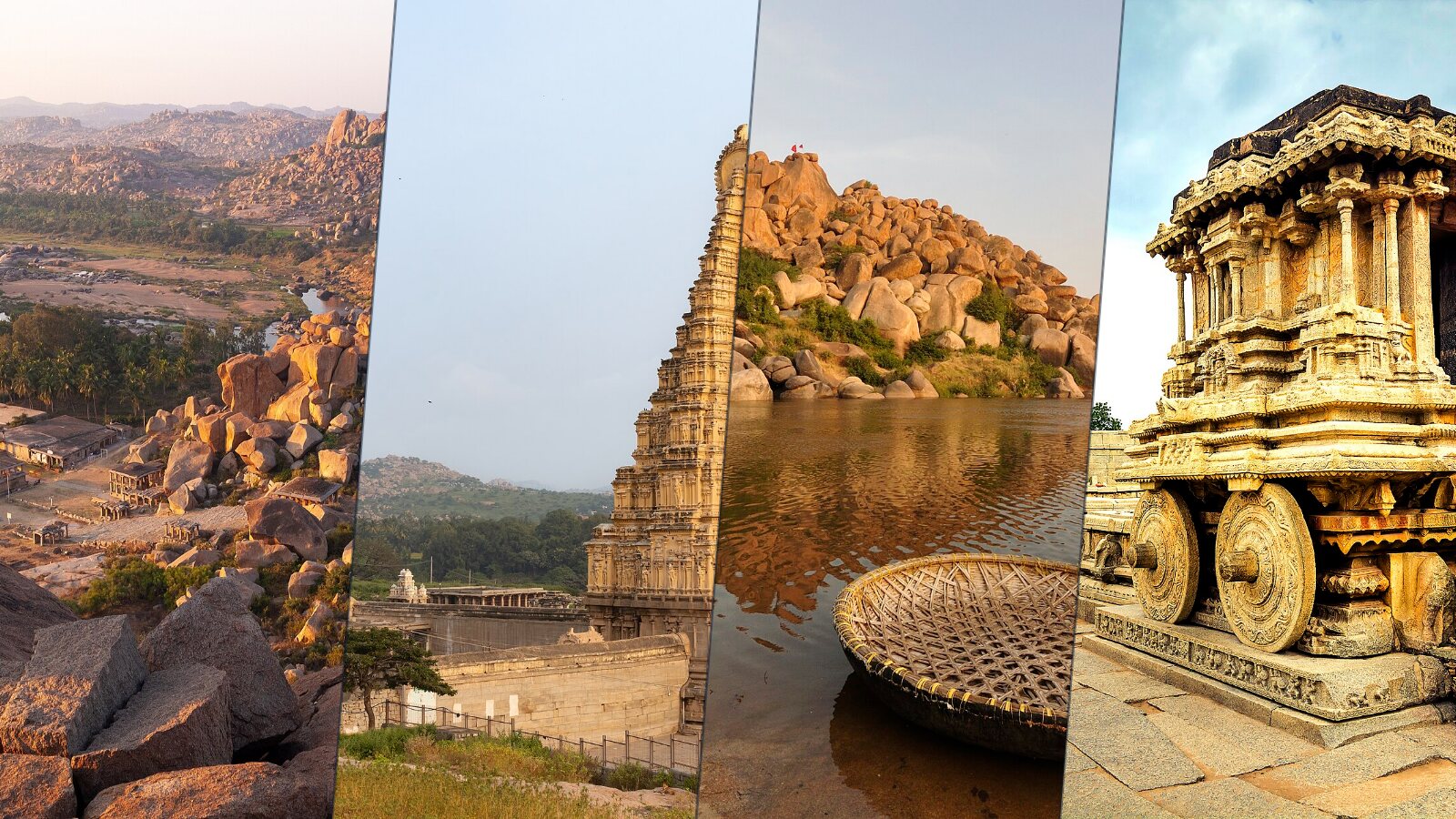
Hampi is one of the most extraordinary places in India. Five hundred years ago it was the capital of the Vijayanagara Empire and one of the richest cities in the world. Today its temples, palaces, bazaars and baths lie scattered across a surreal landscape of giant granite boulders, banana plantations and paddy fields along the Tungabhadra river. A Hampi trip needs a little planning, though, because the ruins are spread across more than 25 square km and the sun is fierce by midday. This guide gives you a two-day plan that splits Hampi into its two main areas, the best sunrise and sunset points, how to get around, where to stay, how to get there and what it costs.
When to plan a Hampi trip
- October to February is the best time. Days are warm and sunny, mornings are cool, and the light on the boulders is beautiful.
- March to May is very hot, often above 40°C. Sightseeing is only comfortable early in the morning and late in the afternoon.
- June to September brings the monsoon. The landscape turns green and the river fills up, but coracle rides and river crossings may stop.
The Hampi Utsav, a festival of music, dance and light shows among the ruins, is usually held in the winter months. Dates vary from year to year.
Hampi's two halves
The ruins are grouped into two main areas, a few km apart:
| Area | What's there | Feel |
|---|---|---|
| The Sacred Centre | Virupaksha Temple, Hampi Bazaar, Hemakuta Hill, Matanga Hill, the Vittala Temple, the riverside | Temples, the river and the boulders |
| The Royal Centre | Royal Enclosure, Mahanavami Dibba, Lotus Mahal, Elephant Stables, Queen's Bath, Hazara Rama Temple | Palaces, platforms and the royal quarters |
Spend one day on each. That's the simplest way to see Hampi properly without exhausting yourself.
A 2-day Hampi itinerary
Day 1: The Sacred Centre and the river
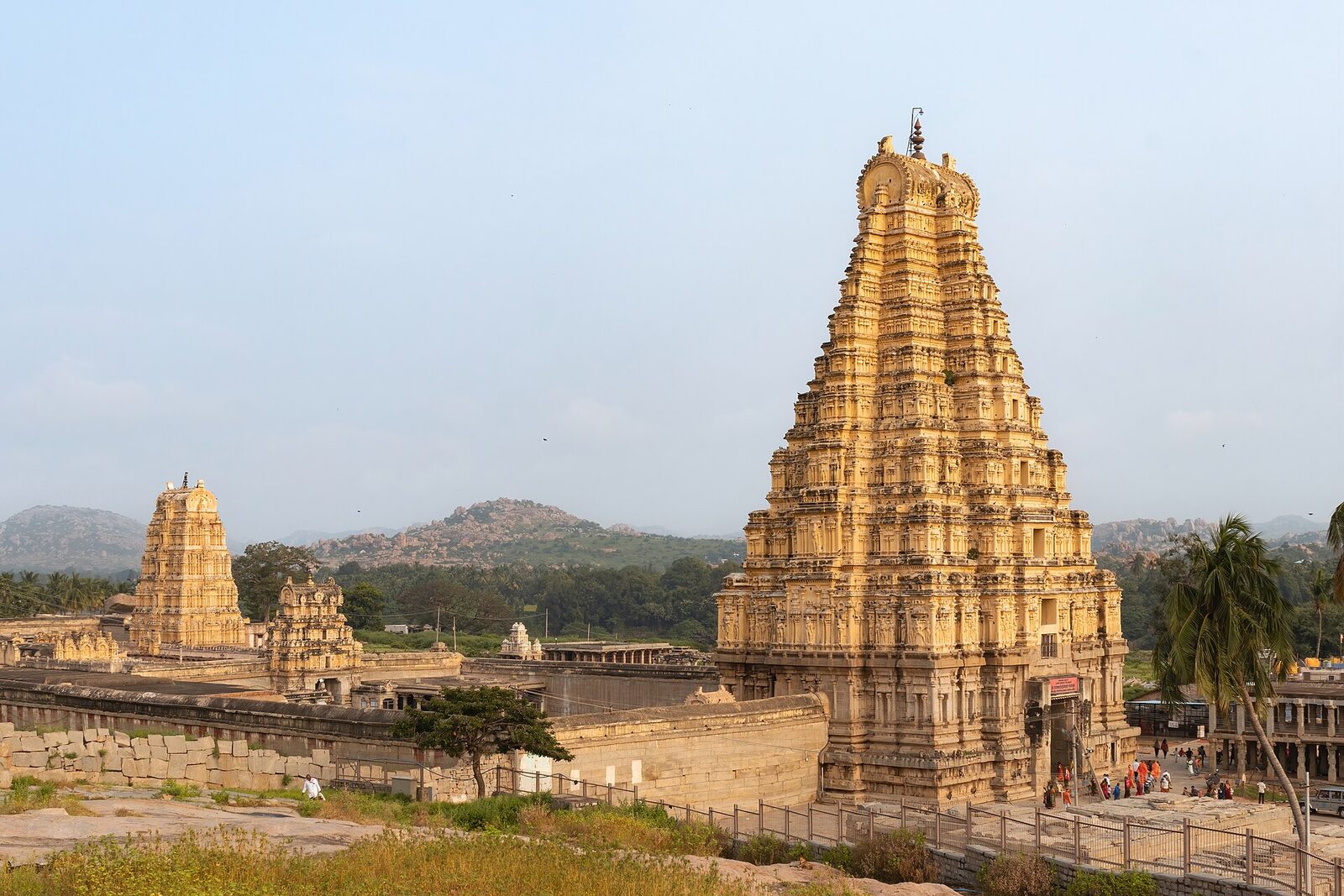
Sunrise on Matanga Hill. Start before dawn with the climb up Matanga Hill, the highest point in central Hampi. It takes about 20 to 30 minutes on steep rock steps, and the view of the sun rising over the boulders and temple towers is one of the best in India. Go with a group, carry a torch and wear shoes with grip.
Virupaksha Temple. Come down to the Virupaksha Temple, still a living temple, with its tall gopuram at the end of Hampi Bazaar. Look for the pinhole camera effect in a small chamber, where the gopuram's image appears upside down on the wall.
The riverside walk to Vittala. Walk along the Tungabhadra past the Achyutaraya Temple, the King's Balance and boulders carved with images, about 2 km, to the Vittala Temple (about ₹40). This is Hampi's masterpiece: the famous stone chariot, now on the ₹50 note, and the musical pillars of the main hall, which ring when tapped (touching them is no longer allowed, to protect them). Battery vehicles also run to Vittala from the main road if you'd rather not walk.
Afternoon on the water. Take a coracle, a round basket boat, on the river near Sanapur or the Virupaksha ghat. It's about ₹300 for a short ride.
Sunset on Hemakuta Hill. End the day on Hemakuta Hill, beside the Virupaksha Temple, where small temples stand on a sloping sheet of granite. It's an easy walk up and the sunset over Hampi is spectacular.
Day 2: The Royal Centre
Start early, as the Royal Centre is more exposed to the sun.
- Hazara Rama Temple: the royal chapel, its walls carved with panels of the Ramayana, processions, horses and dancers
- Royal Enclosure and Mahanavami Dibba: the great platform from which the kings watched the Dasara festivities, and the stepped tank nearby
- Lotus Mahal: a graceful pavilion in the Zenana enclosure, mixing Hindu and Islamic styles
- Elephant Stables: a long building with domed chambers for the royal elephants
- Queen's Bath: an ornate bathing hall with balconies over a sunken pool
- Underground Shiva Temple and the stepped tank nearby
- Lakshmi Narasimha: the huge monolithic Narasimha statue, and the Badavilinga beside it, standing in water
A single ticket covers the Vittala Temple, the Lotus Mahal and Elephant Stables areas on the same day, so keep it with you.
In the late afternoon, cross the river to Anegundi, a village older than Hampi, and climb the 570-odd steps of Anjanadri Hill, said to be Hanuman's birthplace, for the sunset.
Hampi is big and hot. Rent a bicycle, an e-scooter or a scooter, or hire an auto-rickshaw for the day, and carry at least two litres of water each. Plan the open sites for before 11 am and after 3:30 pm.
Extending your Hampi trip
- Badami, Aihole and Pattadakal: about 140 km away, the "cradle of Indian temple architecture", with 6th-century cave temples at Badami and the UNESCO-listed temple group at Pattadakal. Give it one or two days.
- Daroji Bear Sanctuary: about 15 km from Hampi, where you can watch sloth bears from a watchtower in the evening.
- Tungabhadra Dam: a large reservoir near Hosapete, with gardens and a viewpoint.
A one-day Hampi plan
Only have a day? Start with sunrise on Hemakuta Hill (easier than Matanga), visit the Virupaksha Temple, then take an auto to the Vittala Temple before 10 am. After lunch, see the Royal Centre: the Lotus Mahal, Elephant Stables, Hazara Rama Temple and the Queen's Bath. End with sunset back on Hemakuta or at the river. It's rushed, but it covers Hampi's highlights.
Hampi with children or older parents
Hampi works well for families if you avoid the midday heat. Hire an auto for the day instead of cycling, visit the Royal Centre in the early morning, keep the afternoons for rest, and choose a stay with easy road access in Kamalapur or Hosapete. Skip the steep climbs to Matanga and Anjanadri with older parents. Children love the stone chariot, the coracle rides, the giant Ganesha statues and scrambling on the smaller boulders, and the Daroji bear sanctuary makes a good evening outing.
How to get to Hampi
By train: the nearest station is Hosapete (Hospet), about 13 km from Hampi, with overnight trains from Bengaluru and trains from Hyderabad and Goa. Autos and buses run from Hosapete to Hampi.
By air: the nearest airport is at Jindal Vijaynagar (Toranagallu), about 35 km away, with a few flights. Bengaluru and Hubballi have far more.
By road: Hampi is about 338 km from Bengaluru, around 6 hours on JrnyLoop's estimate, mostly on good highway. It's also a popular long weekend from Hyderabad and Goa. Overnight sleeper buses run from Bengaluru and Goa to Hosapete.
Where to stay in Hampi
| Area | Price a night | Why |
|---|---|---|
| Hampi Bazaar area | about ₹800 to ₹2,500 | Guesthouses near the Virupaksha Temple, walk to the Sacred Centre |
| Across the river (Virupapura Gadde, Sanapur) | about ₹800 to ₹3,000 | Quiet, among paddy fields and boulders, reached by boat |
| Kamalapur | about ₹1,500 to ₹5,000 | Closer to the Royal Centre, including a government resort |
| Hosapete | about ₹1,500 to ₹5,000 | Bigger hotels, 13 km away |
| Heritage and boutique resorts | ₹9,000 and up | Luxury stays among the boulders |
The river crossing between Hampi and the far bank stops around 6 pm, and doesn't run when the river is high. If you're staying across the river, check the last boat time every day.
What a 2-day Hampi trip costs
A rough budget per person, for two people sharing, not counting travel to Hampi:
| Budget | Mid-range | |
|---|---|---|
| Stay (2 nights, per person) | ₹800 to ₹2,500 | ₹3,000 to ₹6,000 |
| Food (per day) | ₹300 to ₹600 | ₹700 to ₹1,400 |
| Bicycle, scooter or auto | ₹300 to ₹800 a day | ₹1,200 to ₹1,800 a day for an auto |
| Entry fees and coracle | ₹300 to ₹400 | ₹400 to ₹600 |
| Total for 2 days | ₹2,500 to ₹6,000 | ₹7,000 to ₹13,000 |
Hampi is one of the best-value trips in India. For more ideas, see our guide to planning a budget trip in India.
What to eat
Hampi's cafés serve everything from South Indian thalis to Israeli and Italian food, a legacy of its backpacker years. Try a North Karnataka meal of jolada rotti (jowar flatbread) with ennegayi (stuffed brinjal) in Hosapete, and fresh banana from the plantations. Hampi Bazaar is largely vegetarian and alcohol isn't served near the temples.
Cafés, shopping and evenings
Hampi's evenings are slow: a rooftop café near the bazaar, a game of cards, and the stars over the boulders. Shops in the bazaar sell Lambani embroidery, banana-fibre crafts and books on Vijayanagara history. Hampi Bazaar closes early, and most of the town is quiet by 10 pm.
Hampi travel tips
Start every day early. Sunrise on Matanga Hill and the morning at Vittala are the best hours in Hampi, and the coolest.
Dress for temples and the sun. Cover shoulders and knees for temples, and wear a hat and sunscreen for the ruins.
Wear proper shoes. You'll be climbing rocks and walking on uneven stone.
Hire a licensed guide for the history. Guides at Vittala and Virupaksha bring the ruins to life. Ask for the government-licensed ones.
Respect the monuments. Don't climb on carvings or scratch the stone, and don't touch the musical pillars.
The history of Hampi in a few paragraphs
Hampi was the capital of the Vijayanagara Empire, founded in 1336, which ruled much of South India for more than two centuries. At its height in the early 16th century, under Krishnadevaraya, it was one of the largest and richest cities in the world, visited by Persian and Portuguese travellers who described its bazaars of gems, horses and spices.
In 1565, after the empire's army was defeated at the Battle of Talikota, the city was sacked and abandoned. What you see today are the ruins: temples, palace platforms, markets, aqueducts and baths, scattered over a landscape of granite boulders. Hampi became a UNESCO World Heritage Site in 1986.
More temples worth finding
- Hazara Rama Temple: the royal chapel, with Ramayana panels on its walls
- Achyutaraya Temple: a vast, quiet temple complex in a valley below Matanga Hill
- Krishna Temple and the Krishna Bazaar in front of it
- Badavilinga: a huge lingam standing in water, next to the Lakshmi Narasimha statue
- Kadalekalu and Sasivekalu Ganesha: two giant monolithic Ganesha statues on Hemakuta Hill
- Malyavanta Raghunatha Temple: a hilltop temple with a peaceful sunset view
Hampi's landscape
The boulders that make Hampi so striking are granite, shaped over millions of years by weather into rounded piles and balanced rocks. Around them are banana plantations, sugarcane and paddy fields, irrigated by channels that date back to Vijayanagara times. It's a landscape best seen slowly, by bicycle or on foot, in the soft light of early morning or late afternoon.
Bouldering in Hampi
Hampi is one of the best bouldering destinations in the world. Climbers come from all over to tackle its granite boulders, especially across the river around Virupapura Gadde. If you're a beginner, go with a local climbing guide who can provide crash pads and show you safe routes. Respect any restrictions near monuments.
Common mistakes in Hampi
- Sightseeing in the midday heat. Start at dawn and rest after lunch.
- Missing the last boat back across the river around 6 pm.
- Trying to see everything in a day. Two days is the minimum.
- Underestimating distances and trying to walk everywhere.
- Skipping the sunrise at Matanga Hill. It's the best hour in Hampi.
Hampi's festivals
- Hampi Utsav, also known as the Vijaya Utsav, is a festival of music, dance and lights among the ruins, organised by the Karnataka government. It's usually held in winter, but the dates change each year, so check before you plan.
- The Virupaksha temple car festival draws pilgrims in spring, when the temple chariot is pulled along the Hampi Bazaar.
- Maha Shivaratri brings crowds to the Virupaksha temple, one of the oldest working temples in India.
During these festivals, stays fill up quickly, so book in advance.
Where to watch sunrise and sunset
Hampi is famous for its sunrises and sunsets over the boulders:
- Matanga Hill: the classic sunrise, with views over the whole site. The climb is steep and best done with others.
- Hemakuta Hill: an easy walk from the bazaar, with sunset views over the Virupaksha temple.
- Anjanadri Hill: across the river, with about 570 steps, for sunset over paddy fields and boulders.
- The Malyavanta Raghunatha temple: a quieter sunset spot, away from the crowds.
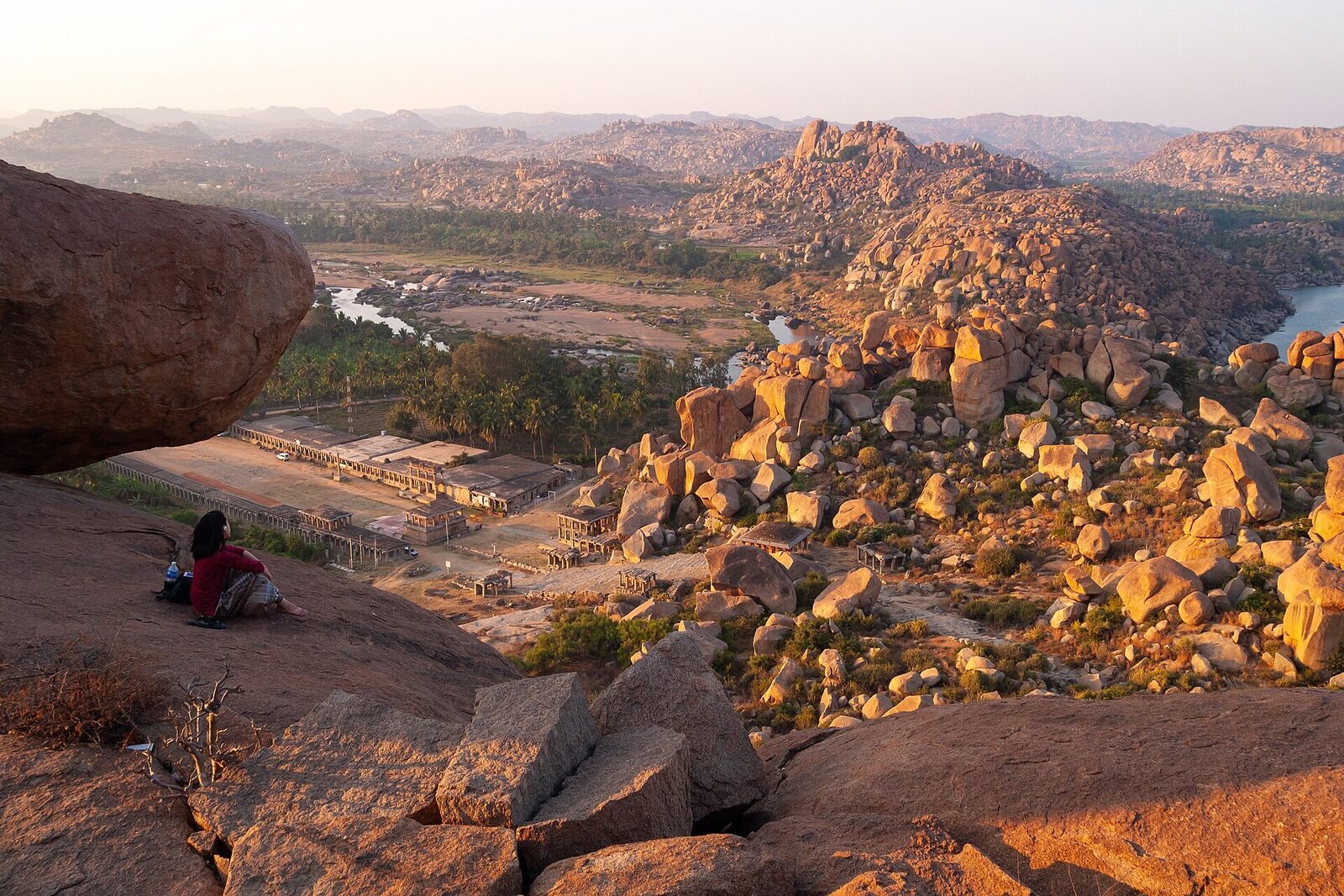
Carry water and a torch, and come down with others after dark.
Hampi in the monsoon
From about July to September, Hampi turns green, and the Tungabhadra river runs full. It's a beautiful time to see the ruins without the crowds or the heat. But when the river is high, the coracle rides and the small ferry between the Hampi side and Virupapur Gaddi can stop, so check before you plan to cross. The boulders are slippery after rain, so skip the climbs when it's wet.
Plan your Hampi trip with JrnyLoop
Tell JrnyLoop where you're starting and that you're going to Hampi, and it plans the journey by road or train, then lays out each day with the sights grouped by area, Matanga Hill at sunrise, Vittala in the morning and Hemakuta at sunset, with times and entry fees for each stop. It budgets the trip for your group and packs for the heat.
Hampi is one of the best places to visit in India in winter, and a great long weekend from Bangalore or Hyderabad.
The short version
Go between October and February, and give Hampi two full days. Spend the first on the Sacred Centre, from sunrise on Matanga Hill to sunset on Hemakuta, with the Vittala Temple and a coracle ride in between. Spend the second on the Royal Centre and end at Anjanadri Hill. Rent a bicycle or hire an auto, start early, carry water, and stay at least one night near the ruins.


Comments