Planning a budget trip in India starts with one question: how much will it cost? Most people answer it with a guess. Then the guess turns out ₹8,000 short, half of it on things nobody counted, like the cab from the station or the parking at every sight.
This guide shows you how to plan a budget trip in India with real numbers: where the money actually goes, what a typical trip costs at different comfort levels, the changes that save the most, and the places where your money goes furthest. The figures come from the cost model JrnyLoop uses to estimate every trip it plans, so you can check our maths.
How much does a trip in India cost per day?
Across the destinations in JrnyLoop's guides, the middle of the range looks like this:
| Stay style | Room per night | Food per person per day | A day for one, sharing a room |
|---|---|---|---|
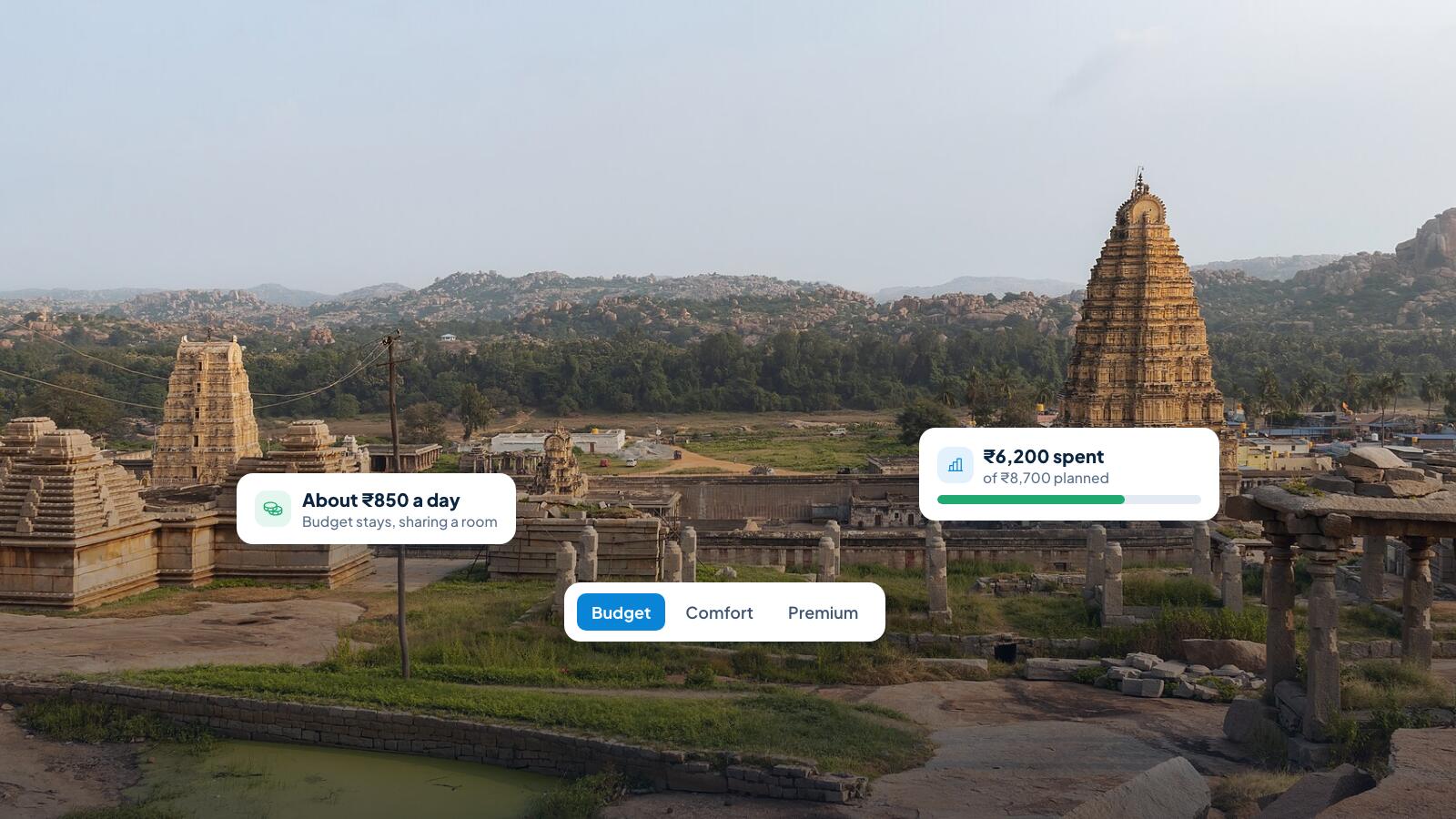
| Budget | about ₹1,000 | about ₹350 | about ₹850 |
| Comfort | about ₹3,000 | about ₹700 | about ₹2,200 |
| Premium | about ₹8,000 | about ₹1,500 | about ₹5,500 |
Those are the costs of being somewhere: a bed and three meals. Add getting there and back, getting around, entry fees and a little extra, and you have the whole trip. Big cities, islands and the high mountains cost more; small towns, pilgrim towns and heritage sites usually cost less.
Where the money goes on a trip
Every trip budget has five parts. Knowing them is half the battle, because a budget is usually blown by the part you forgot, not the part you planned.
| Part | What it covers | How it scales |
|---|---|---|
| Travel and fuel | Getting there and back, plus getting around once you're there | Per person (trains, buses, flights) or per vehicle (car, bike) |
| Stay | Hotels, homestays and hostels | Per room, per night |
| Food | Three meals and the chai in between | Per person, per day |
| Activities | Entry fees, safaris, boat rides | Per person |
| Everything else | Parking, tips, water, the odd souvenir | About 7% of the rest |
That last line matters more than it looks. JrnyLoop adds about 7% on top of every estimate for exactly these things. Leave it out of your own budget and you'll feel it on the last day.
What a trip really costs: a worked example
Let's take a classic short trip: 3 days in Jaipur from Delhi, for two people, with about ₹800 each in entry fees (Amber Fort, City Palace and a couple more). Here's what JrnyLoop's cost model gives at each stay style, travelling three different ways:
| Getting there | Budget stays | Comfort stays | Premium stays |
|---|---|---|---|
| Car | ₹12,000 | ₹19,500 | ₹39,400 |
| Train | ₹8,700 | ₹17,500 | ₹39,900 |
| Bus | ₹8,700 | ₹17,800 | ₹39,900 |
All figures are for the two of you, together, rounded. The three stay styles are:
- Budget: hostels, homestays and simple hotels
- Comfort: good 3-star hotels and cottages
- Premium: resorts and boutique stays
Two things jump out.
The stay style changes the cost far more than how you travel. Going from Budget to Premium stays more than triples the trip, whichever way you get there. Choosing between a car, a train and a bus, by comparison, moves the total by a few thousand rupees at most.
A car makes most sense with a full car. For two people, the car is the priciest of the three at Budget level, because fuel and tolls (about ₹5,200 for the round trip) cost the same whether there are two of you or five. Put four friends in that car and the same Budget trip comes to about ₹18,400, or ₹4,600 each, against ₹6,000 each for a couple driving it.
These are planning estimates, deliberately rounded. They assume about 280 km each way, a day of local sightseeing and Jaipur's typical prices. Your own trip will differ, but the shape of the numbers rarely does.
What your budget buys
Using the same Jaipur trip for two as a guide, here's roughly what different budgets get you on a short trip of three days:
- About ₹10,000 for two: a nearby city or hill town by train or bus, with Budget stays and local food. Jaipur by train comes to about ₹8,700, which leaves a little room to spare.
- About ₹20,000 for two: the same trip with Comfort stays (good 3-star hotels), or a Budget trip somewhere farther away. Jaipur by train with Comfort stays is about ₹17,500.
- About ₹40,000 for two: Premium stays on a short trip, or a longer trip with Comfort stays, or a flight to somewhere you couldn't reach by road in a weekend.
Stretch the same money over more days and the per-day cost falls, because the journey there and back is paid once. A five-day trip often costs well under twice a two-day one.
The biggest ways to save
1. Choose your stay style first
Since stays are the biggest lever, decide your style before anything else. One night in a Comfort hotel in Jaipur costs about three times a Budget room; a Premium one, about nine times. You don't have to pick one style for the whole trip, either. A simple room for the nights you're out all day and a nice one for the night you'll actually enjoy it is often the best value of all.
2. Travel overnight
An overnight train or sleeper bus does two jobs: it gets you there and it saves a night's stay. On longer routes (Delhi to Jaisalmer, Bengaluru to Goa, Mumbai to Goa) this alone can save a few thousand rupees per trip, and you arrive with a full day ahead.
3. Fill the car, or share the room
Costs that are per vehicle or per room drop fast as the group grows. JrnyLoop's estimates assume two people to a room (three for families), one car per five people and one bike per two. A group of four in one car and two rooms pays far less per head than a couple doing the same trip.
4. Go just outside the peak
Prices follow demand. Christmas to New Year, Diwali and long weekends are the most expensive times almost everywhere. Go a week before or after, or travel Sunday to Thursday instead of over a weekend, and the same room often costs noticeably less.
5. Pick places where money goes further
Some destinations are simply cheaper to be in. Spiritual towns and heritage sites in particular have plenty of good, simple stays and filling meals at low prices. More on that below.
6. Eat where the locals eat
A thali at a busy local restaurant costs a fraction of a café meal and is usually better. JrnyLoop's destination guides list the dishes and places each place is known for. Most of them are not expensive.
7. Count the last mile
Trains and flights stop at the station or airport, not your hotel. For places like Manali (whose nearest big railhead is about 250 km away) or Munnar (about 110 km from the station and the airport), that last stretch by taxi can cost more than the train. JrnyLoop adds it to the estimate, so it never comes as a surprise.
8. Use the free stuff
Ghats, beaches, viewpoints, markets, sunrise and sunset cost nothing. A good plan mixes a few paid sights with plenty of free ones.
9. Book transport early
Trains on popular routes fill up weeks in advance, especially around festivals and holidays, and last-minute options (premium fares, private cabs, flights) cost a lot more. As soon as your dates are fixed, book the long journeys first. Hotels can usually wait a little; the overnight train usually can't.
10. Keep a buffer
Set aside about 10% for the unexpected: a missed train, a closed road, a bad hotel you want to leave. A trip with a buffer feels relaxed; a trip without one feels tense.
Places where your money goes further
These are some of the most affordable places in JrnyLoop's destination guides, with the typical cost of a Budget room and a day's food:
| Place | Budget room, per night | Food, per person per day | Best months |
|---|---|---|---|
| Haridwar, Uttarakhand | ₹700 | ₹250 | Oct–Apr |
| Pushkar, Rajasthan | ₹700 | ₹300 | Oct–Mar |
| Rishikesh, Uttarakhand | ₹700 | ₹350 | Sep–Nov, Feb–May |
| Varanasi, Uttar Pradesh | ₹800 | ₹300 | Oct–Mar |
| Hampi, Karnataka | ₹800 | ₹300 | Oct–Feb |
| Puri, Odisha | ₹800 | ₹250 | Oct–Mar |
| Madurai, Tamil Nadu | ₹800 | ₹250 | Oct–Mar |
| Khajuraho, Madhya Pradesh | ₹800 | ₹300 | Oct–Mar |
With two people sharing a room, that's roughly ₹600–700 each a day for a bed and three meals, before travel and entry fees. Compare that with places like the Andaman Islands or Gulmarg, where a Budget room starts at about ₹1,500–2,000 a night.
Notice how many are pilgrim and heritage towns. They're built to host large numbers of visitors on modest budgets, so simple guesthouses, dharamshalas and ashram stays are easy to find, and the food is mostly vegetarian thalis that cost little and fill you up. Many of their biggest sights, from the ghats to the temples, are free to visit.
Plan a budget trip in India with JrnyLoop
You can do all of this with a spreadsheet. JrnyLoop just does it faster, and keeps it honest while you travel.
Let your budget pick the places
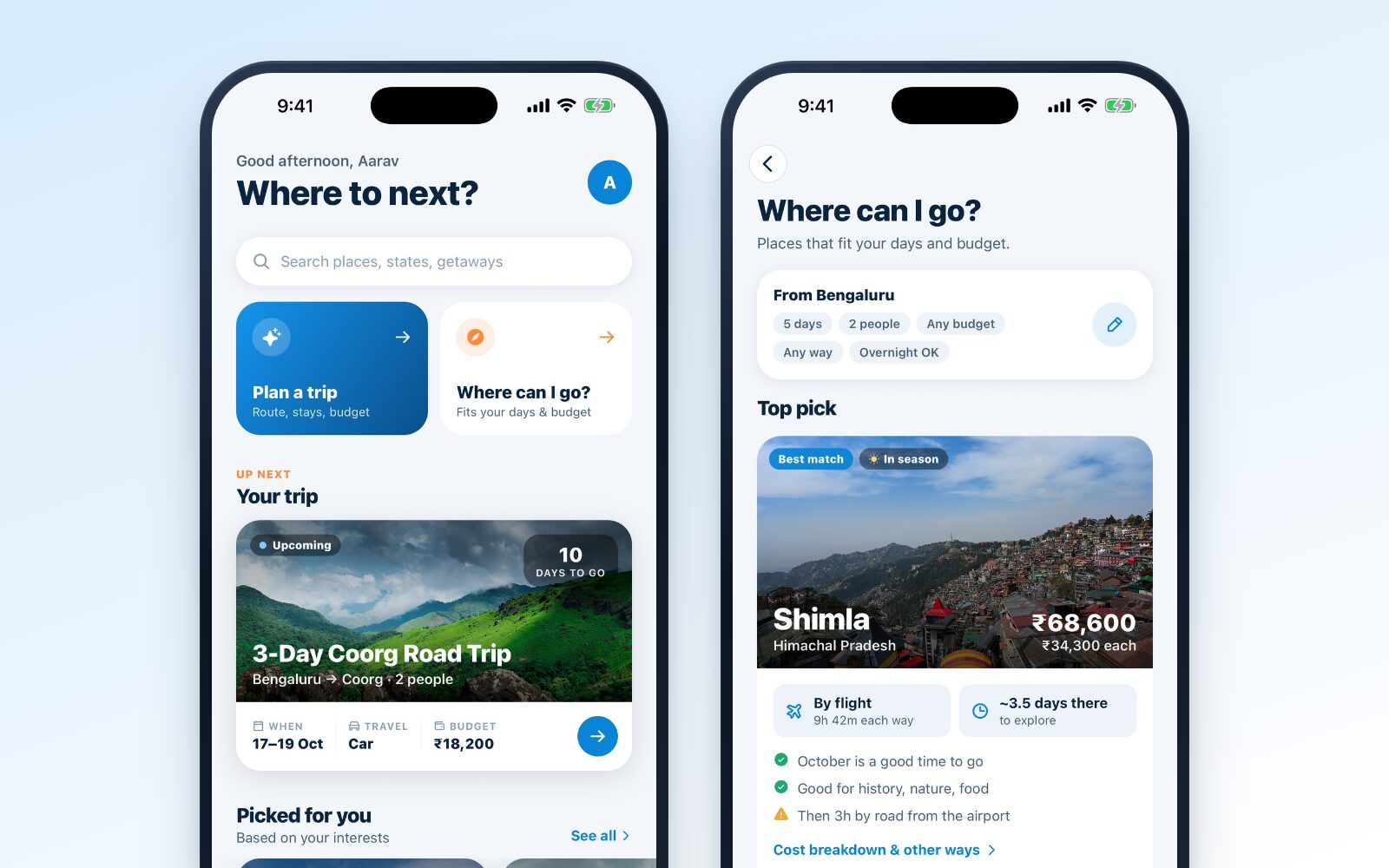
Open Where can I go?, enter your city, your days, your group and your budget for the group. JrnyLoop shows the places that fit, each with its total cost and its cost per person, and how you'd get there. Places a little over your budget (up to about a quarter) still show, so you can see what a stretch would buy, with a plain note like "About ₹2,000 over your budget, even on budget stays." Sort by Cheapest to see the best-value options first.
Let your budget pick the stays
When you plan a trip with a budget, JrnyLoop picks the most comfortable stay style your budget allows: Premium if it fits, then Comfort, then Budget. If even Budget stays are over, it tells you straight, with something like: "Even on a tight budget this trip comes to about ₹14,000 — over your ₹10,000. Try fewer days, a closer destination or a cheaper way to travel." No pretending.
Leave the budget empty and you get a comfortable mid-range plan.
See the whole estimate, then change it
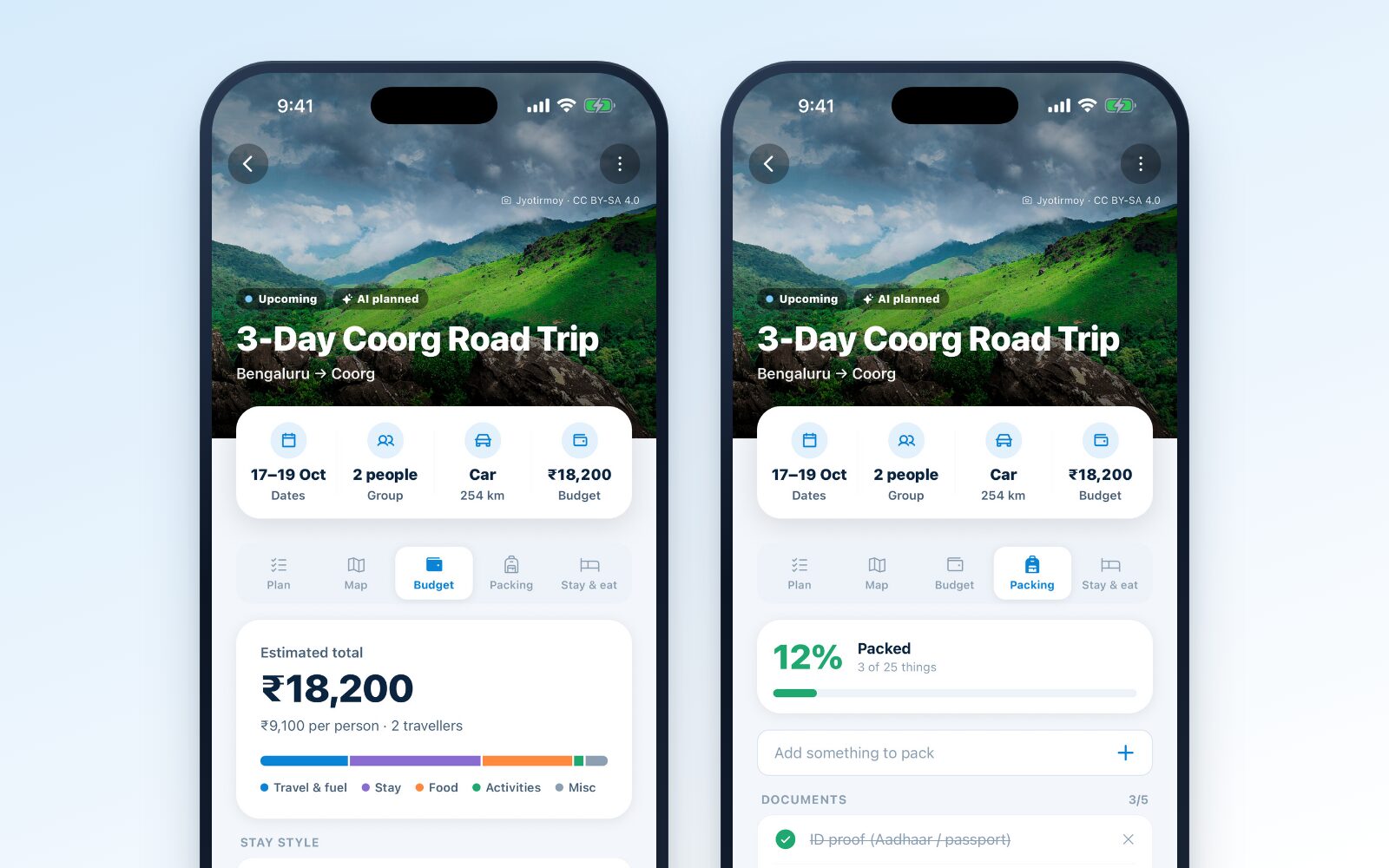
The trip's Budget tab shows the estimate for the group and per person, split into travel and fuel, stay, food, activities and miscellaneous. Switch the stay style between Budget, Comfort and Premium and the whole trip re-prices on the spot. Change the dates or the number of people from the trip's menu and the budget follows.
Track what you actually spend
Once you're travelling, add expenses as they happen: fuel, transport, stay, food, activities, shopping or miscellaneous. The Budget tab shows what you've spent against the plan, category by category, so "we're over on food" is something you notice on day two, not after you're home.
Split it fairly
Travelling with others? Anyone on the trip can add what they paid and who it was for, split equally or by exact amounts. JrnyLoop keeps everyone's balance, and Settle up works out the fewest payments to square everyone at the end. Our guide to planning a group trip with friends has a worked example.
How JrnyLoop works out a trip's budget
No black box. These are the assumptions behind every estimate, so you can adjust for your own trip:
| Part | How it's estimated |
|---|---|
| Car | Fuel at about ₹104 a litre and 14 km a litre, plus about ₹1.40 a km in tolls, per car (one car per five people) |
| Motorcycle | Fuel at 35 km a litre, one bike per two people |
| Train | About ₹0.55 a km per person on Budget, ₹1.40 on Comfort and ₹2.40 on Premium (at least ₹300 a ticket), plus the road from the station |
| Bus | About ₹1.10 to ₹2.40 a km per person, depending on the style |
| Flight | A base fare plus distance, higher for Premium, plus the road from the airport |
| Getting around | Your own vehicle's fuel, or local cabs from about ₹900 a day |
| Stay | The destination's room rate for your stay style, two people a room (three for families) |
| Food | The destination's daily food cost for your stay style, per person |
| Activities | The entry fees of the sights in your plan |
| Everything else | About 7% on top |
The rates per kilometre roughly follow the classes you'd book: sleeper and general seats for Budget, AC three-tier for Comfort, AC two-tier and above for Premium. Everything is rounded to the nearest hundred, because this is a planning estimate, not a quote. Fares, fuel prices and room rates change, so check before you book.
Budget tips by travel style
Solo. Rooms cost the same for one as for two, so a solo trip pays more per head for stays. Hostels and dorms fix that, and they're the easiest place to meet other travellers. Trains and buses are your best value, since you're paying per seat, not per car.
Couples. You're the group the room maths was made for. Spend the savings on one special night rather than three average ones.
Friends. The bigger the group, the cheaper the car and the rooms per person. Agree on a per-person budget before anyone books, and log expenses from day one.
Families. A family room for three or four usually costs less than two separate rooms. Plan shorter driving days (JrnyLoop does this automatically for families), and keep a bigger buffer for the unexpected.
Common budget mistakes
- Forgetting the way home. It's half the transport cost. JrnyLoop includes the journey home by default.
- Leaving out local transport. Cabs, autos and jeeps at the destination add up, especially in hill stations.
- Ignoring tolls and parking on road trips. JrnyLoop's estimates allow about ₹1.40 a kilometre for tolls on national highways, and it adds up fast on a long drive.
- Planning on peak-season prices you saw off-season (or the other way round).
- No buffer. Something always costs more than expected.
Your budget trip checklist
- Total budget agreed (and the per-person share, if it's a group)
- Stay style chosen: Budget, Comfort or Premium
- Dates checked against holidays and peak weeks
- Long journeys booked first, overnight where it makes sense
- The last mile from the station or airport counted
- Entry fees for the big sights added
- A 10% buffer set aside
- Expenses logged from day one
The short version
- Decide the stay style first; it's the biggest lever.
- Travel overnight and fill the car or the room.
- Avoid the peak weeks, or book them early.
- Pick places where money goes further.
- Add the last mile, the misc and a buffer.
- Track spending as you go, and split it fairly.
A budget trip in India doesn't have to mean a worse trip, just a better planned one. Tell JrnyLoop your budget, and it will show you where it can take you.
Plan your budget trip on JrnyLoop. Looking for ideas? Start with these places to visit in India in winter, or our guide on how to plan a road trip in India.


Comments