A road trip in India is the best way to see the country, and the easiest one to get wrong. The map says six hours; the highway, the town traffic, the ghat road and the chai stop say nine. Plan the drive like it's a straight line and the trip turns into a race against the sunset.
This guide covers how to plan a road trip in India properly: how far you can really drive in a day, where to stop for the night, what it costs, the paperwork, and how to handle mountains, monsoons and long days on a bike. Along the way, we'll show the rules of thumb JrnyLoop uses to plan drives, because they're the same ones you'd want to follow anyway.
Before you start: pick the right season
The same road can be a dream in one month and a mistake in another. Roughly:
- October to March is the season for the plains, Rajasthan, Gujarat, central India and the south. Days are dry and pleasant, and the deserts are cool.
- April to June is for the hills. Himachal and Uttarakhand are at their best while the plains bake.
- The high Himalaya (Ladakh, Spiti and the high passes) opens for the summer, usually from around June to September. The exact dates depend on the snow each year, so check before you plan.
- July and August are the hardest months for mountain and ghat roads, because of landslides and closures. The Western Ghats are beautiful in the monsoon, but plan shorter days and a spare one.
- The Northeast is best from about October to April.
When you give a trip dates in JrnyLoop, it checks the season for your destination and the forecast for each day once it's close, so you know before you go.
Step 1: Be realistic about distance
The first rule of driving in India: don't trust the map's time. Navigation apps assume free-flowing roads. Indian highways have trucks, tractors, toll plazas, speed breakers, cattle and towns that the highway runs straight through.
When JrnyLoop plans a road trip, it takes the routing time and stretches it: by about 30% for a car and 45% for a motorcycle, a calibration it checked against real drive times on routes like Delhi–Jaipur, Delhi–Manali and Bengaluru–Ooty. Mountain and ghat roads get their own cap, because on hairpins you won't average much more than about 25 km an hour, however good the tarmac.
Then there's how long you can comfortably drive in a day. These are the limits JrnyLoop plans with, in hours of actual moving time (breaks come on top):
| Travelling by | A comfortable day of moving |
|---|---|
| Car | About 8½ hours |
| Car, with family | About 6¾ hours |
| Motorcycle | About 7 hours |
| Bus | About 12 hours |
A Relaxed pace takes another 15% off; a Packed one adds 15%. Any stretch longer than that gets split at an overnight halt.
A useful rule of thumb on plains highways: plan on 300–400 km in a full day by car, less in the hills. If a route is longer, plan a night on the way rather than a 5 am start and a midnight arrival.
Good first road trips
If you haven't done a long drive in India before, start with a route that's long enough to be a trip but short enough to forgive mistakes:
| Route | Roughly | Good for |
|---|---|---|
| Chennai → Pondicherry | 150 km | A coastal drive along the ECR |
| Delhi → Rishikesh | 240 km | Hills, river and cafés at the end |
| Bengaluru → Coorg | 250 km | Coffee estates, with Mysuru on the way |
| Bengaluru → Ooty | 270 km | Forests and a ghat road |
| Delhi → Jaipur | 280 km | Easy highway, forts at the end |
| Mumbai → Goa | 590 km | A two-day coastal trip with a halt |
Distances are approximate; JrnyLoop shows your exact route and its real drive time. On the Bengaluru to Ooty road, note that the highway through the Bandipur and Mudumalai forests closes to traffic at night, so plan to cross in daylight.
Step 2: Choose where to stop for the night
A long drive split well is a better trip, not just a safer one. The night in Mandi on the way to Manali, or a stop in a coastal town between Mumbai and Goa, often becomes the part you remember.
Good overnight halts have three things: a choice of places to stay, food that's open late, and a fuel pump nearby. Highway towns usually beat stopping in the middle of nowhere.
JrnyLoop does this for you. Any stretch longer than a comfortable day is split at a named town on the way, and the day ends with "Check in" at a sensible hour. If you'd rather choose, add up to three stops on the way when you plan, and the route goes through them in order. Long stretches between your stops still get split.
Step 3: Time your driving day
How you shape the day matters as much as the distance.
- Start early on long days. JrnyLoop starts a long driving day at around 6:30 am (6 am on a bike) and a shorter one at 8. The early hours are the emptiest on the road.
- Break every couple of hours. Plan a 15-minute chai break about every two hours of driving, or every 90 minutes on a bike. It's the single best thing you can do against fatigue.
- Lunch around 1 pm. Forty-five minutes at a dhaba resets everyone, and the driver most of all.
- Arrive before dark. Especially in the hills. Mountain roads are slow and unlit, and that's when most trouble starts.
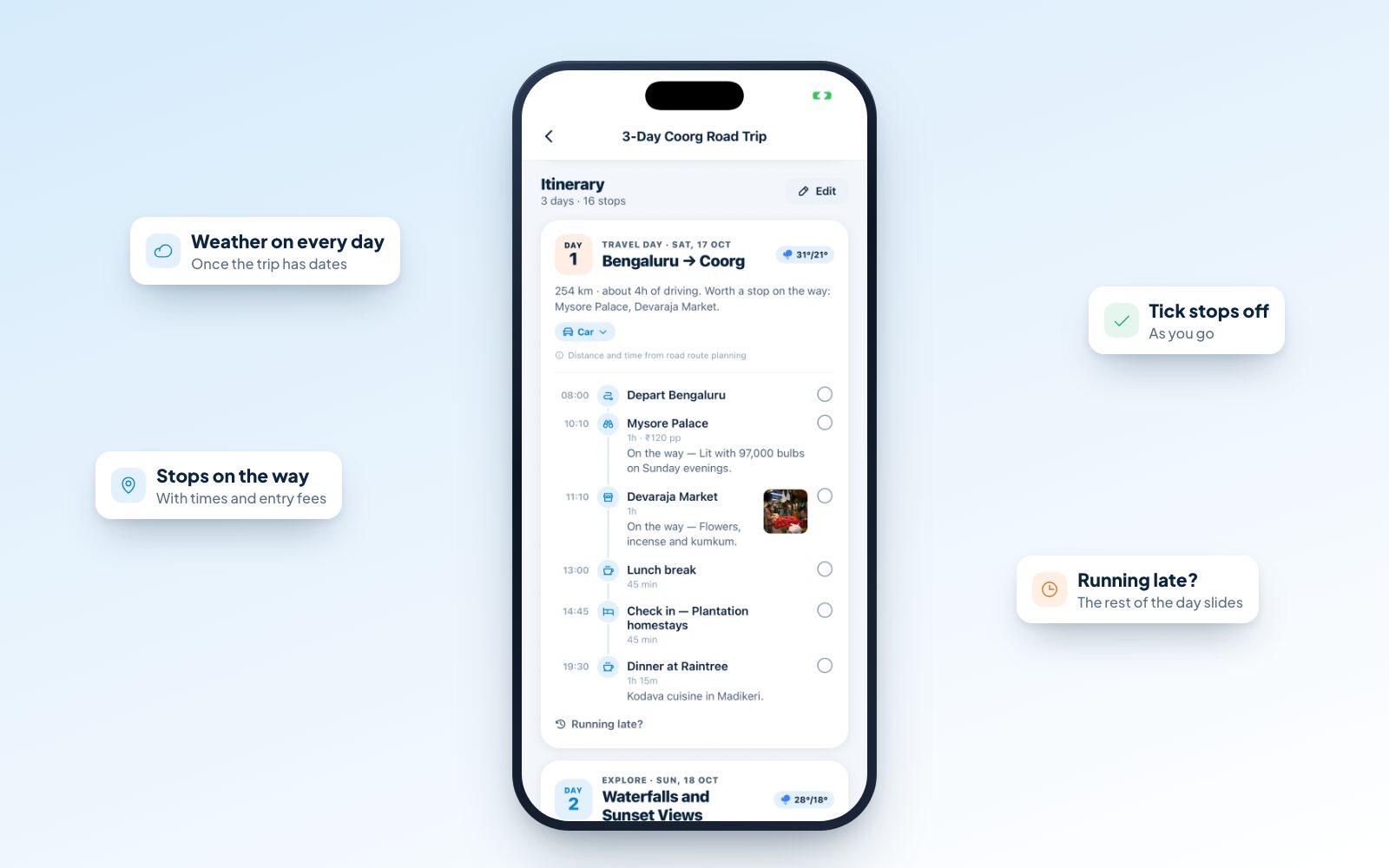
- Stop for the good stuff. A road trip isn't just the destination. JrnyLoop adds sights near the road to travel days, like Mysore Palace on the way from Bengaluru to Coorg.
Here's what a travel day looks like when it's planned this way:
Share the driving
If more than one person in the car can drive, take turns. Swap at the chai breaks, roughly every two hours, so nobody does a whole day at the wheel. The person in the front passenger seat has a job too: navigation, tolls, music, and keeping the driver talking on the long, straight stretches where drowsiness creeps in. And whoever drives the last stretch of the day should be the one who's freshest, not the one who's most confident, because that's usually the hardest part of the road.
Avoid driving at night
If there's one piece of road trip advice to take seriously, it's this one. At night, highways fill with trucks, unlit vehicles and animals on the road, and ghat roads lose the visibility you need on every bend. Plan your days so you arrive by sunset, and if a day is running long, stop early rather than pushing on.
Step 4: Work out what it will cost
A road trip budget has five parts: fuel and tolls, stays, food, entry fees and activities, and a little extra for everything else. Here's how to estimate the first one, which is the one people usually get wrong.
Fuel = distance ÷ your vehicle's mileage × the fuel price. JrnyLoop's estimates assume petrol at about ₹104 a litre, a car doing 14 km a litre and a motorcycle 35 km a litre. Adjust for your own vehicle.
Tolls vary by road, but about ₹1.40 a km for a car on national highways is a fair planning number.
For a Delhi to Jaipur trip (about 280 km each way, 560 km in all) by car, that's roughly:
| Cost | How it's worked out | Estimate |
|---|---|---|
| Fuel | 560 km ÷ 14 km/l × ₹104 | about ₹4,200 |
| Tolls | 560 km × ₹1.40 | about ₹800 |
| Local driving | A day of sightseeing in town | about ₹300 |
| Total for the car | about ₹5,200 |
Notice that this is per car, not per person. Four friends in one car pay a quarter each, which is why road trips get so much cheaper as a group. On a motorcycle, two people share one bike's fuel.
Then add stays (per room, per night), food (per person, per day), entry fees, and a buffer of about 7% for parking, tips and the things you forget. JrnyLoop adds all of this up for your group when it plans the trip, and shows it per person too. For more on stays, food and the styles in between, see how to plan a budget trip in India.
Step 5: Paperwork and your vehicle
Documents to carry
- Your driving licence
- The vehicle's registration certificate (RC)
- Valid insurance
- A valid pollution under control (PUC) certificate
Digital copies in DigiLocker or mParivahan are accepted by traffic police, but keep paper or offline copies too in case you have no signal. Driving a borrowed car? It helps to carry a note from the owner along with the papers.
FASTag is required at national highway toll plazas, and you pay more without a working one. Top it up before you leave, because recharging at a remote plaza with no network is no fun.
JrnyLoop's packing list for a road trip includes these (licence, RC, insurance, PUC and your FASTag balance), so you can tick them off with everything else.
A pre-trip vehicle check
- Tyres, including the spare, at the right pressure and with good tread
- Jack, wheel spanner and a tow rope
- Brakes, lights, indicators and wipers working
- Engine oil, coolant and brake fluid topped up
- Battery terminals clean and tight
- A first-aid kit, a torch and a phone charger for the car
- Drinking water and some snacks
What to keep in the car
Beyond the documents and the spare tyre, a few things make long days easier: a phone mount and a car charger, a power bank, sunglasses, a reusable water bottle for each person, wet wipes, a small bag for rubbish, some cash for places that don't take UPI, and a playlist everyone can live with. In the hills, add a warm layer for each person even in summer. The weather changes fast up there.
Step 6: Mountains, monsoon and other special cases
Driving in the hills
- Use a lower gear going downhill instead of riding the brakes.
- Honk at blind bends and keep to your side.
- Give way to vehicles coming uphill. It's the convention on narrow mountain roads, because restarting on a slope is harder.
- Reach before dark. JrnyLoop adds this as a tip to any mountain travel day that ends at your destination.
- Watch for snow and closures in winter. High passes close for the season, and roads can shut for a day or two after heavy snowfall.
High altitude
Going above about 3,000 metres (Ladakh, Spiti, parts of Sikkim and Arunachal)? Altitude sickness is real, and driving up fast makes it worse. Ascend gradually and keep the first day easy. JrnyLoop plans the first day at a high-altitude destination as an acclimatisation day: "short walks, lots of water, early night."
Some of these places also need an entry permit, even for Indian visitors, such as an Inner Line Permit for Arunachal Pradesh or for Nubra Valley and Pangong in Ladakh. If your destination or a stop on the way needs one, JrnyLoop says so on the trip and adds the paperwork to your packing list.
Monsoon
Mountain roads in July and August bring landslides and long delays. If you're planning a hill drive then, JrnyLoop warns you: "July–August brings landslides on mountain roads — keep a buffer day." Take that buffer day seriously, and check road conditions each morning.
Step 7: On the road
Once you're driving, a few habits keep the trip on track.
- Keep the plan offline. In the JrnyLoop app, trips you've opened stay on your phone, so the plan opens in the dead zones every highway has.
- Know where the essentials are. In the trip's Stay & eat tab, JrnyLoop lists the nearest hospital or clinic, pharmacy, ATM and fuel pump near each night's stay. Where a small town has none mapped nearby, it tells you to carry cash from the last big town.
- Let the day slide when it has to. Stuck behind a landslide or a slow ghat? Tap Running late? and the rest of the day moves back. Anything you've pinned as fixed, like a hotel check-in or a booked activity, stays put.
- Switch a leg if you need to. Tired of driving? Change the travel mode for just one day, say to a train for the way back, and it's re-timed and re-priced.
- Log fuel and tolls as you go. Add each expense with who paid and who it was for, and JrnyLoop works out who owes whom at the end.
Save two numbers in your phone before you leave: 112, India's single emergency number, and 1033, the national highways helpline.
Riding a motorcycle?
Bike trips need a few extra rules:
- Ride shorter days. About 7 hours of riding is a full day, and breaks every 90 minutes keep you sharp. JrnyLoop plans bike trips this way automatically.
- Wear the full gear: a proper helmet, jacket, gloves, boots and rain gear, even when it's hot.
- Check the chain, tyres and brakes before every long day, and carry a basic tool kit and a puncture kit.
- Ride in daylight, and never on a mountain road after dark.
Riding as a group? Our sister app, RydrLoop, is built for group rides. It shares everyone's live location on the ride, so no one falls behind or takes a wrong turn unnoticed. JrnyLoop links to it whenever you plan a trip by bike.
Plan a road trip in India in a few minutes
Everything in this guide (the realistic drive times, the overnight halts, the breaks, the fuel and toll costs and the packing list) is what JrnyLoop works out when you plan a trip by car or bike:
- Open Plan a trip and set where you're starting and where you're going.
- Add stops on the way if you want them, your dates and who's coming.
- Pick Car or Bike, your budget and your pace.
- Tap Plan my trip, and check the travel days, the budget and the packing list.
New to JrnyLoop? Our guide on how to plan a trip in India with JrnyLoop walks through every screen. Looking for where to drive this season? Try our list of places to visit in India in winter.
Your road trip checklist
- Route planned with realistic driving days
- Overnight halts chosen and stays booked
- Licence, RC, insurance and PUC in the car (and offline copies)
- FASTag topped up
- Vehicle checked, spare tyre included
- Permits sorted, if your route needs them
- Trip opened on your phone so it works offline
- 112 and 1033 saved in your phone
- First-aid kit, water, snacks and a torch packed
- Each day planned to arrive before dark
Plan your road trip on JrnyLoop: it's free, and the drive times are planned for real Indian roads.


Comments